Showing posts with label computer generated furniture. Show all posts

Friday, April 1, 2011

From Virtual 3D To Reality: Peter Donders New Aluminum Morphs Chair, The Shelly.


Belgium-based designer Peter Donders, who specializes in 3D Design, Modelling, Prototyping, Manufacturing & Visualisation, Furniture Design & Development has just released his newest chair in his Morphs collection. Using various software programs Peter designs his pieces on the computer in 3D and then fabricates them for the real world.


above: designer Peter Donders atop his carbon fiber stone, another piece in his Morphs collection

Shelly, is a beautiful single chair cast from one entire piece of aluminum and has an elegant fluidity with an interplay of organic curves that makes it stand out from other functional chairs.


Aluminium chair, cast in 1 piece in a 3D printed sand mould.

The chair consists of only 1 single surface (shell) with a minimum thickness of 8mm.

Weight +/- 12 kg

Dimensions:
H : 962 mm
W: 579mm
D: 667mm
Price on demand.
If you are interested in purchasing the Shelly, contact him here.

Peter Donders
Opitterkiezel 206
B-3960 Opitter Bree
Belgium
Tel/Fax : 0032 (0)89 864 888
Mobile : 0032 (0) 496 25 67 93

Sunday, June 20, 2010

When Computers And Classics Collide: Sebastian Brajkovic's Lathe Furniture


SEBASTIAN BRAJKOVIC

Last Spring, Carpenters Workshop Gallery had a showing of Sebastian Brajkovic's collection of work, entitled Lathe. The exhibit consisted of a series of several chairs and one aluminum table, all of which combine classic furniture design with computer inspired 'stretching' to create a modern interpretation of antique style furniture.

The work is so innovative and unusual that one of the pieces from the exhibition, Lathe VIII, has even been entered into the prestigious permanent collection of the Victoria and Albert Museum.

"They are called Lathe because of the apparent rotating effect of the design. In fact the word Lathe comes from the Latin word used to convey the idea of milk being stirred. My very first thought with making this design was actually a practical one. I wanted to create more space on a singular chair by “extruding” the seat’s surface area." says Sebastian.


The artist continues "This extruding idea came from a Photoshop function where you can pick a row of pixels and extend them as long as you want. This modern computer method aided me to devise new ways of sketching as a contradictory partner in my design process. In this paradoxical sense, using antique forms was the next logical step."


His artistic process starts by deconstructing historical pieces of furniture, in particular seventeenth-century chairs, then through a combination of wood carving, bronze casting and hand embroidering, he reconstructs an entirely new vision, as you can see from the pieces below.

Lathe I:


Above: Lathe I, 2008
H 85 L 114 W 114 cm
Bronze, embroidered upholstery
Edition of 8


Lathe II:


Above: Lathe II, 2008
H 100 L 102 W 62 cm
Bronze, embroidered upholstery
Edition of 8

Lathe III:


Above: Lathe III, 2006
H 94 L 74 W 67 cm
Bronze, hand embroidered
Edition of 8

Usually the materials or forms I use are from products that already proved themselves as worthy. Like the lathe chair series for instance, the forms are used from old chairs, these old chairs lay easy on the eye because they are recognizable, in a way they are accepted. If I want to explain a chair that looks like its moving, it will explain itself better when you recognize the old and familiar chair in it.
---- Sebastian Brajkovic


Lathe V (in various color versions):


Above: Lathe V, 2007
H 94 L 94 W 54 cm
Bronze, hand embroidered
Edition 8

Lathe VIII (shown below) adopts the idea of the traditional love seat, which is created by connecting two baroque-style chairs by an extruded backrest. The elaborate embroidery on the upholstery of the backrest is a significant element of this work. The regular overlapping of the outline across the entire width of the backrest creates the impression of movement which is reminiscent of super slow-motion shots รก la Matrix. Brajkovic accordingly seems to integrate the moment of morphing, the element of time as a fourth dimension, into the object.


Above: Lathe VIII, 2008
H 105 L 140 W 85 cm
Bronze with nitric-acid burned patina and needle stitched embroidered fabric
Edition of 8

Made of aluminium, the Lathe Table is quite literally created by being turned on a real lathe. In this incarnation however, the chisel carves aluminum directly instead of the traditional wood. The evocative sense of movement is conveyed in the spinning lines of the quasi vortex, offering the past impression of a moment of great movement and now stillness. Inspired originally by a child’s spinning top, whizzing around at high speed, it has the same illusion that once at its optimal speed it is no longer moving but standing up straight. The highly polished surface is a product of the lathe turning technique which polishes as it carves the metal. He explains that whereas the Lathe Chairs are more like painting, in that modifications can be made during the production process, the Lathe Table is a one step process which is an honest and direct application of the Lathe concept.

The Lathe Table:


Above: Lathe Table, 2008
H 30 L 119 W 119 cm
lathe turned aluminium
Edition of 8

About the designer:
Sebastian Brajkovic was born 18th September 1975 in Amsterdam from a Dutch-Indonesian mother and a Croatian-Italian father.

After completing a course in cabinetmaking at school he applied for both the Rietveldt and Designacademy being torn between an art and design education. He chose the Designacademy with a view to make art that wanted to be design or visa versa. He studied under Gijs Bakker, Hella Jongerius and Jurgen Bey. He continues his studies in philosophy at the University of Utrecht. He carried out an invaluable internship at Jurgen Bey's studio. In June 2006 Brajkovic graduated with the "Lathe Chairs" and "Home Grown" projects.

The above pieces, if not yet sold, are available for purchase from:
The Carpenters Workshop Gallery,
3 albemerale street, london w1s 4he

special thanks to Spazio Rossana Orlandi and Dezeen for some additional images.

Saturday, December 12, 2009

Dizzying Design: Deform House & Deformscape Backyard From Faulders Studio


Five years ago, architect Thomas Faulder was hired by Jeff Dauber to transform his
Potrero Hills home into a living residence/art gallery space. The result was Faulder Studio's "Deform House".


The third-level addition, which was approximately 1,200 sq. ft., was constrained by existing structural walls and neighboring structures. With the need to maximize vertical wall surfaces for art, the design emphasized the ceiling plane with a pattern of optically shifting grooves.

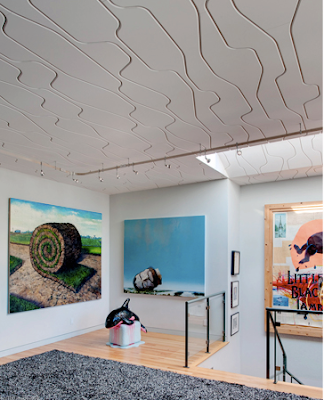

Sheathing the entire top floor ceiling and rear wall, this lining unifies the spaces and is in contrast with the architectural neutrality of the smooth walls.


The entry gate, perfect for an Apple geek like Dauber, is perforated with a security warning written in binary code text:


The door as it appears at night:


But last year, the backyard got a new look as well. A dizzying plywood floor that transformed the 550 square foot backyard into a Tron-like illusory vortex.


Though the surface of the San Francisco backyard that Faulders created for Jeff, a senior Apple exec, appears to bend and dip toward the Japanese maple tree, it is actually a flat horizontal plane made up of individual plywood tiles.


The outdoor extension, called "deformscape" to the private dwelling is situated in the tightly packed urban neighborhood. The limited space outdoor sculpture garden inherits a large tree, and uses this sole arboreal presence to establish a gravitational pattern of grooves that are focused towards the tree's centroid.


What seem to be painted black lines are, in reality, gaps: the tiles sit atop industrial-fiberglass grating that allows rainwater to drain through to the tree’s roots.


To generate the resultant pattern, a 3-dimensional bulge is formed around the tree, and its distorted wire-grid projected onto a 2-dimensional surface. Taking into account appearance effects created by perspective views from inside, the resultant planar surface appears sink around the tree.


all images courtesy of Faulders Studio and a special thanks to Metropolis Magazine for some additional info.

About Thom Faulders:
Architect Thom Faulders, founder of Faulders Studio, creates client-based projects at a wide array of building scales, as well as hypothetical architectural proposals and speculative exhibitions that explore interfaces between space, perception, and context. The office situates the practice of architecture within a broader context of performative research and material investigations that negotiate dynamic relationships between users and environments.

In combination with practice, Thom Faulders is an Associate Professor in Architecture at CCA/California College of the Arts in San Francisco. He has previously taught at UC Berkeley College of Environmental Design, as Visiting Studio Critic at the Royal Institute of Technology in Stockholm, Sweden, and in numerous workshops addressing issues in contemporary architecture, including the CCA 333 Program and the SCI-Arc 2+2+2 Summer Graduate Program. He has been a design jury critic at many institutions, including UCLA, Penn Design, University of Toronto, Columbia, Cranbrook, Harvard, and SCI-Arc.

Visit the Faulder Studio site here.

Many of the wonderful photos in this post are courtesy of Theodor Rzad, see more of his beautiful architectural photography here: Images © DIGITED IMAGE COMPANY